










My Calligraphy Experience: 者知音
During the fall term of 1976, I took a graduate-level calligraphy course at the University of Hawaii. The instructor assigned me the phrase 者知音 (sha chi yoin in Japanese), and at midterm he asked each student to submit what we considered our finest work for the Third All-Japan Student Calligraphy Competition, sponsored by:
• The Hieizan Calligraphy Federation
• The Japan Calligraphy Education Federation
My entry, 者知音, was honored with the 特選 (Highest Honor) distinction, and I received a certificate officially presented to “Barry Cotton,” dated November 23, 1976 (Showa 51). The award ceremony took place at Enryaku-ji Temple on Mt. Hiei-zan—one of the most venerated spiritual centers of Japanese culture.

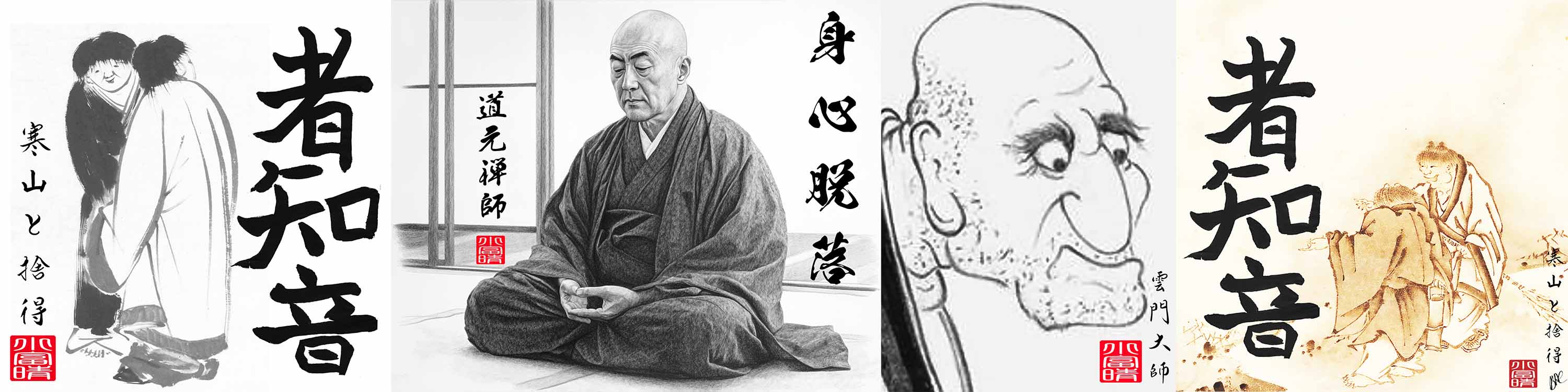
Although the original version was not returned to me, I retained a photo of my work (shown below).

The Phrase 者知音 (zhě zhī yīn)
In Chinese, 者知音 (zhě zhī yīn) refers to a true friend or kindred spirit—someone who understands your thoughts and feelings on a profound level. In Japanese, this phrase is often read as sha chi yoin and carries a similar meaning, emphasizing an especially deep connection or mutual understanding between friends.
This concept derives from a famous Chinese story about the musician Bo Ya and his friend Zhong Ziqi. The tale underscores the bond between two individuals whose shared sensitivity and empathy transcend ordinary communication.
The Bo Ya and Zhong Ziqi Legend
According to legend, Bo Ya was an exceptionally gifted lute player who expressed his emotions through music. Zhong Ziqi, capable of grasping the subtleties and depth of Bo Ya’s melodies, became his sole confidant. When Zhong Ziqi passed away, Bo Ya was so devastated by the loss of his only true listener that he broke his instrument and vowed never to play again.
This story, which appears in texts such as the Liezi (a fourth-century Daoist classic), highlights several central themes:
• True Friendship: Bo Ya and Zhong Ziqi’s relationship exemplifies a bond where one person fully understands the other’s inner world.
• Understanding and Empathy: Zhong Ziqi’s unique ability to perceive the essence of Bo Ya’s music represents deep emotional communion.
• Loss and Grief: Bo Ya’s reaction to Zhong Ziqi’s death testifies to the profound sorrow one can experience upon losing a soulmate.
• Art and Expression: Music, in this narrative, emerges as a powerful medium for communicating one’s innermost emotions—one that remains incomplete without a receptive and sympathetic audience.
Over time, the phrase 知音 (zhī yīn) came to symbolize true friendship or a soulmate-like connection, inspiring references in both Chinese and Japanese culture.
An Artistic Depiction: Circle of Kano Motonobu
A notable visual representation of this legend is found in a hanging scroll titled “Bo Ya Plays the Qin as Zhong Ziqi Listens,” attributed to the circle of Kano Motonobu (1477–1559) from the Muromachi period (1392–1573). Created around the 1530s, it likely once formed part of a set of sliding-door panels (fusuma).
In the painting, Bo Ya and Zhong Ziqi seek shelter from a storm beneath a cliff, passing the time with music. Though unsigned, the work reflects the early Kano school’s formal landscape style. Traditional attributions to Motonobu himself have been questioned, suggesting instead that it was produced by an artist under his influence.

Bo Ya Plays the Qin as Zhong Ziqi Listens, 1530s
Japan, Muromachi period (1392–1573)
Hanging scroll; ink and color on paper; Image: 65 1/16 × 34 1/4 in. (165.2 × 87 cm)
Overall with mounting: 8 ft. 10 7/8 in. × 40 13/16 in. (271.5 × 103.7 cm) Overall with knobs: 8 ft. 10 7/8 in. × 43 3/16 in. (271.5 × 109.7 cm)
The Metropolitan Museum of Art, New York, Mary Griggs Burke Collection, Gift of the Mary and Jackson Burke Foundation, 2015 (2015.300.67)
http://www.metmuseum.org/Collections/search-the-collections/53233
As a tribute to Bo Ya and Zhong Ziqi and their 者知音 (zhě zhī yīn) I created the following work by superimposing my calligraphy on an image from a hanging scroll of Hanshan and Shide (Japanese: Kanzan and Jittoku) who are popular figures in Zen painting who have been depicted many times as a pair, and the duo is a motif in Zen painting and representative of deeper meanings in Zen Buddhism as a whole. The scroll is titled 豊干寒山拾得図 and was created by Reisai in the first half of the 15th century. The work has been made available under the Creative Commons CCO 1.0 for Universal Public Domain use. Ref:File:豊干寒山拾得図-Fenggan, Hanshan, and Shide MET DP361145.jpg

Reisai (霊彩?) est un peintre de l’école de peinture à l’encre suiboku de l’époque de Muromachi dont le musée national de Tokyo conserve une œuvre, Monju (le bodhisattva Manjusri), rouleau en hauteur à l’encre sur papier doré, qui est répertoriée au registre des Biens Culturels Importants1.

Enryaku-ji Temple and Mount Hiei-zan
Enryaku-ji Temple, situated atop Mount Hiei (Hieizan), is a UNESCO World Heritage Site and the headquarters of the Tendai sect of Japanese Buddhism. Founded in 788 by the priest Saichō at Emperor Kammu’s request, its original purpose was to protect the new capital of Heian-kyō (Kyoto) from malevolent spirits believed to enter from the northeast.

Historical Significance
• Peak Influence: At its zenith, the complex encompassed over 3,000 buildings with several thousand monks, many of whom later founded other major sects of Japanese Buddhism. Enryaku-ji served as a crucial site for both religious and political developments in medieval Japan.
• Downfall and Revival: The temple once fielded its own armed forces, which led to Oda Nobunaga’s devastating attack in 1571, leaving most of the site in ruins. Although it never regained its full medieval grandeur, Enryaku-ji was gradually rebuilt, retaining its aura of devotion and mystery.
• Spiritual Traditions: Visitors today can experience activities such as sutra copying (shakyo), zazen meditation, and calligraphy. The temple also features altars that have been continuously lit by lanterns for over 1,200 years.
Cultural Life on Mount Hiei
Mount Hiei is also known for the kaihōgyō, a rigorous seven-year training program for Tendai monks that involves calligraphy, meditation, and demanding physical disciplines. Many who undertake this path spend additional years serving at Enryaku-ji, reinforcing its status as a major center of Buddhist scholarship and spiritual practice.

Saichō, Kūkai, and Their Legacy
Saichō (最澄, 767–822) (SHOWN LEFT) and Kūkai (空海, 774–835) played pivotal roles in the spread of Buddhism and calligraphy in Japan:
1. Buddhist Sects:
• Saichō founded the Tendai school, and Kūkai established the Shingon school. Together, they introduced esoteric Buddhist teachings to the imperial court and broader society.
2. Calligraphic Contributions:
• Kūkai was recognized as one of the era’s greatest calligraphers, credited with shaping kana script and penning influential treatises such as Bunkyō hifu ron on Chinese poetic criticism.
3. Cultural Exchange and Friendship:
• Saichō invited Kūkai to perform the abhiṣeka (esoteric initiation) for the court, while Kūkai taught Saichō and his disciples in Mikkyō rituals. Their cooperation laid the foundation for several aspects of Japanese Buddhist practice.
4. Ongoing Veneration:
• The Tendai sect commemorates Saichō annually on June 4th with a memorial service, underscoring his lasting importance to Japanese Buddhism and cultural identity.
Concluding Reflections
The phrase 者知音 (sha chi yoin / zhě zhī yīn) symbolizes the profound connection and empathy shared by true friends, a concept vividly illustrated by the ancient legend of Bo Ya and Zhong Ziqi. My personal journey with this calligraphic work—which earned special recognition in Japan—has been enriched by the heritage of Enryaku-ji Temple, the spiritual environment of Mount Hiei, and the enduring influence of cultural luminaries like Saichō and Kūkai.
Ultimately, both the calligraphy and the history behind it serve as a testament to how art, spiritual practice, and human connection can converge, transcending time and culture to inspire people across centuries.
Another of my works is 道 (way or road), but it has broad philosophical and cultural overtones as it is used in Japan in naming arts (the DO in 書道 shodo) and martial arts (the DO in JUDO).

“Tao the Way” refers to the core concept of Taoism, a philosophy that originated in ancient China.
The Tao, or Dao, is the natural order of the universe, and is sometimes described as the “way of the universe”.
- The Tao is a difficult concept to define, and is best experienced through everyday life.
- The Tao has three aspects: the Way of Nature, the Way of Reality, and the Way of Human Life.
- Taoists believe that the primary goal of life is to align oneself with the Tao.
- Taoism teaches that all living things should live in harmony with the universe and the energy within it.
- The Chinese character for Tao, 道, can mean “way”, “path”, “road”, “doctrine”, or “principle”.
- The philosophy of Taoism is attributed to Chinese philosopher Lao Tzu.
Additional resources
- Tao: The Watercourse Way by Alan Watts is a book that explores the Tao.
- “Taoism Explained – The Art of Flow | Lao Tzu” is a YouTube video that explains Taoism.