IRAN 40 YEARS AGO #1

Forty years ago this week, a Pan Am 747, staffed by an all-volunteer crew, landed in Tehran to evacuate us to Frankfurt, Germany.

Though Khomeini had guaranteed safe passage for foreigners wanting to leave Iran, all regularly scheduled flights in and out of Iran had been canceled. Fortunately, Pan Am and their voluntary crew risked flying into the heart of a Revolution to get us out.

We had been held up in the Tehran Hilton for three or four days after arriving in a convoy of buses from Isfahan 280 miles south of Tehran. US and Canadian Embassies coordinated evacuation flights from the Tehran Hilton while the Islamic Guard provided ‘security.’ Word was that the Communist Youth Movement that helped Khomeini to power realized they were being betrayed and were attempting to attack the Tehran Hilton. A lot of windows had been shot out on the lower floors of the hotel, and machine gun positions were surrounding the hotel.

Most members of the Islamic Guard had been street cleaners or taxi drivers before the revolution. They lacked discipline or any understanding of how to handle firearms. As a result, they were more of a safety hazard than security. It wasn’t until we arrived at the airport that we saw any real disciplined military. These forces, however, wore distinctive black and white keffiyeh and must have been Shia PLO because Hezbollah did not form until 1985. Perhaps more significant than the black & white keffiyeh were prominent Arab noses.

By the time we boarded the Pan Am flight, we must have been searched, and our passports check dozens of times. Even when seated on the plane, paramilitary figures in black & white keffiyeh carrying AK47s walked up and down the aisles for one last check. The barrel of an AK47 got caught on my cheek as one of them passed by. I endured a gouge Fearing any movement could provoke violence, I sat motionlessly and was gouged. Five minutes later, we were in the air, and a loud cheer reverberated throughout the cabin as the cabin crew broke out the booze.

THE NEW GREEN DEAL

Alexandria Ocasio-Cortez has become the lightning rod of conservative talk shows after introducing a Green New Deal resolution to Congress. The concept is not new. Thomas Freidman coined the idea of a Green New Deal in his book, Hot, Flat, and Crowded in 2007 and British economist Richard Murphy founded the Green New Deal Group the same year. Yet, Ms. Ocasio-Cortez’s resolution has been met with overwhelming skepticism and mockery from the right.

The Green New Deal that Ocasio-Cortez has submitted to Congress can be download on this link and recommends action in three basic areas:

  1. The plan must decarbonize the economy. The young people who will have to live with the effects of climate change want a plan that begins with what is necessary rather than what is deemed politically possible.
  2. The plan must include a jobs guarantee by the federal government and large-scale public investments. Again, the GND is not just climate policy. It’s about transforming the economy, lifting the up the poor and middle class, and creating a more muscular, active public sector.
  3. The plan must make sure it includes protections for those hardest hit by historical discrimination and those set to suffer most from the effects of climate change — in Ocasio-Cortez’s document, “low-income communities, communities of color, indigenous communities, [and] the front-line communities most affected by climate change, pollution, and other environmental harm.”

Alexandria Ocasio-Cortez admits the plan is ambitious as it includes a 10-year commitment to convert “100 percent of the power demand in the United States” to “clean, renewable and zero-emission energy sources,” to upgrade “all existing buildings” to meet energy efficiency requirements, and to expand high-speed rail so broadly that most air travel would be rendered obsolete. “We do not have a choice,” says Ocasio-Cortez. “We have to get to one hundred percent renewable energy in ten years. There is no other option.

The Yale Program on Climate Change Communication sent out a survey to 966 registered voters between Nov. 28 and Dec. 11, 2018, and 81% of voters support a Green New Deal. “Given that most Americans have strong support for the components and ideas of the Green New Deal, it becomes a communication strategy problem,” says Abel Gustafson, who co-authored the survey findings. “From here, it’s about how you can pitch it so you can maintain that bipartisan support throughout the rest of the process.

81% OF VOTERS SUPPORT A GREEN NEW DEAL

Addressing the issue of climate change is being championed by a fifteen year old Swedish climate activist, Greta Thunberg who addressed delegates at the UN sponsored COP24.

click on the video below to view Greta Thunberg’s speech

Since our leaders are behaving like children, we will have to take the responsibility they should have taken long ago. We have not come here to beg the world leaders to care for our future. They have ignored us in the past and they will ignore us again. We have come here to let them know that change is coming whether they like it or not.

WE NEED TO LISTEN AND LEARN FROM OUR YOUTH.

RHETORIC

RHETORIC

The basis of public discourse comes to us from Ancient Greece. Aristotle called it “the faculty of observing in any given case the available means of persuasion.” Aristotle identified three elements to appeal to audiences:

  • logos (λόγος) –  the use of reasoning, either inductive or deductive, to construct an argument.
  • pathos (πάθος) – the use of emotional appeals to alter the audience’s judgment through metaphor, amplification, storytelling, or presenting the topic in a way that evokes strong emotions in the audience.
  • ethos (ἦθος) – Aristotle’s theory of character and how the character and credibility of a speaker can influence an audience to consider him/her to be believable— there being three qualities that contribute to a credible ethos: perceived intelligence, virtuous character, and goodwill.

Throughout history, rhetoric has been taught and studied as the basis of communication and its principles shape how writing is taught in universities throughout the world.

Now, more than ever, the art of rhetoric is needed to shape our nation’s civil discourse as the art of persuasion has been reduced to Tweeting.  Adam Gopnik of The New Yorker writes, “Democracy runs on many things—power, money, political parties—but the power of persuasion is essential to it, and, when persuasion becomes poisoned, the rest gets poisoned, too.”

ON THANKSGIVING

Plymouth! Why put Plymouth in the main menu?

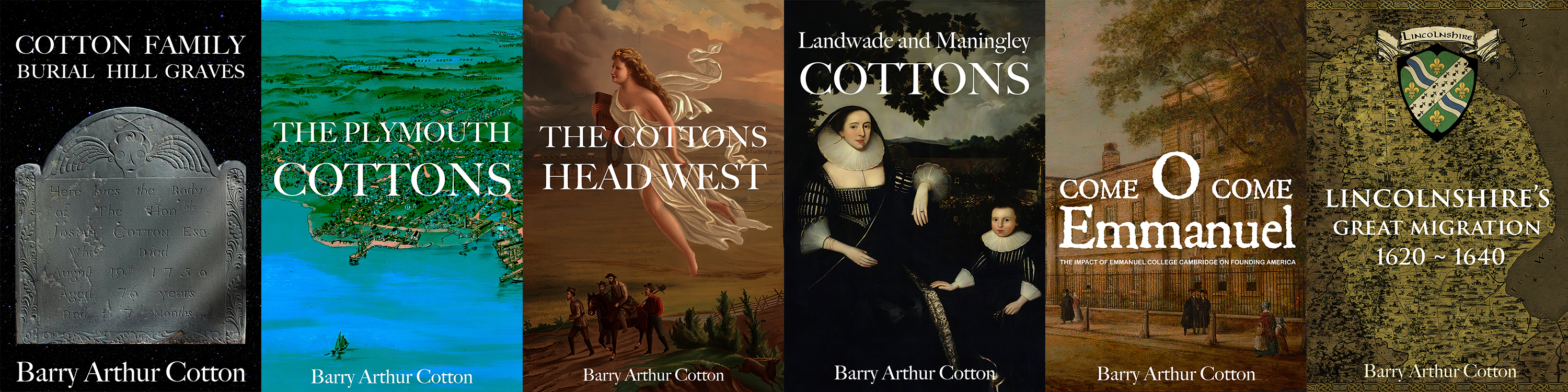
Although I have never lived in Plymouth, Massachusetts, it is the place that the Cotton Family has lived the longest- one hundred and twenty years (1668 to 1788) in my line and two hundred and fifty years (1620 to 1870) overall. As a result, the bones of forty-eight of relatives reside on Burial Hill in Plymouth, Massachusetts.

The Cotton family first appeared in Plymouth in 1668 when Rev. John Cotton Jr. was asked to head the Plymouth Church. Three subsequent generations in my line remained in Plymouth and include 1) Josiah Cotton, son of Rev. John Cotton. 2) Colonel Theophilus Cotton, son of Josiah Cotton, and, 3) Lieutenant John Cotton, son of Col. Theophilus Cotton.

Because Plymouth was founded by passengers of the Mayflower, it is common for early Plymouth families to have intermarried. For the Cotton family, it took four generations for Lt. John Cotton to marry into a Mayflower line. After the War of the Revolution, Lt. John Cotton moved to the Ohio Territory along with his wife and his wife’s parents. Their story follows.

 The Last Will and Testament of Keziah Little

  • Barry A. Cotton
  • (Published in the Mayflower Quarterly Vol. 68 No. 1 March 2002 & edited October 2018)

After the Northwest Territory was ceded to the United States at the Treaty of Fort McIntosh in 1785, the Ohio Company purchased one million acres of land along the Ohio River and a number of families from New England migrated to Ohio in 1788 and 1789.  One of the first families to settle Ohio was Nathaniel Little, his wife Keziah Atwood/Adams, his daughter Lucy and Lucy’s husband Lieutenant John Cotton, who served with Nathaniel Little in the War of Revolution. The marriage of John Cotton and Lucy Little links two of the oldest and most distinguished families of Old Plymouth Colony.  Lucy Little is descended from Richard Warren, Mayflower passenger and signer of the Mayflower Compact.  And, Lieutenant John Cotton is descended from Rev. John Cotton, who fled England in 1633 to escape trial by Charles I for being puritan.

Opening up the Ohio River Valley had been the dream of George Washington ever since he first surveyed the area in 1770.  After the Revolutionary War, Washington’s aide-de-camp, General Rufus Putnam, helped realize this dream by founding the Ohio Company on March 1, 1786 at the Bunch of Grapes Tavern in Boston, Massachusetts.  Another Putnam, Colonel Israel Putnam Jr., joined Rufus Putnam in settling Ohio.  Rufus Putnam and Israel Putnam Jr. were related, as their grandfathers were half brothers.  During Washington’s presidency, Congress made Rufus Putnam the first Surveyor-General of the United States and he is known as the Father of Ohio. Major General Israel Putnam Sr. was a hero at the Battle of Bunker Hill and the father of Colonel Israel Putnam Jr. whom Keziah Little named executor of her Will. Not only was Israel Putnam Jr. named executor of the Last Will and Testament of Keziah Little, he also is shown in the appraisement of Keziah’s estate as having signed a note with Keziah for $368.75 due on June 4, 1814.  Israel Putnam Jr. died just prior to the disposition of the Will of Keziah Little so the court named his son, Aaron Waldo Putnam, executor after a $500 bond was posted with Aaron’s brother David Putnam and Keziah’s grandson, Robert Bradford, who also owed Keziah $33.84 in a note due on June 4, 1814.

The ancestors of the Little, Cotton & Bradford lines (shown below) were all from Massachusetts, and most had lived in Plymouth since the landing of the Mayflower in 1620.  Richard Warren, Mayflower passenger, was one of these and his daughter, Anna Warren, married Thomas Little in Plymouth on 19 April 1633 to establish the Little line in America.  The Cotton family of Old Plymouth Colony was established in 1668 when Rev. John Cotton Jr. became the vicar of the Plymouth Church.  The Bradford Family descends from William Bradford, Mayflower passenger and Governor of Plymouth Colony.  Captain Robert Bradford married Lucy Little’s sister, Keziah Little.  As a result, the Bradford grandchildren (shown below) descend from two separate Mayflower lines. The Last Will and Testament of Keziah Little brings to light a branch of Mayflower descendants previously undocumented in the membership of the General Society of Mayflower Descendants.  Included in this branch are at least five generations descending from the seventeen grandchildren named in Keziah Little’s Will.

  • Little:  (Welthy Little, Charles Little, Henry Little, Lewis Little, Nathaniel Little & George Little)
  • Cotton: (Theophilus Cotton, Lucy Cotton, Joshua Cotton & John Cotton)
  • Bradford: (Robert Bradford, Samuel Bradford & Otis Bradford)
  • Seall:  (Betsy Seall & Morris Seall)
  • Nashe:  (George Nashe)
  • Dier:  ( Sally Dier)

The three witnesses to the signing of the Last Will and Testament of Keziah Little also originated from New England and were among the first families to settle Ohio. Colonel Ebenezer Battelle graduated from Harvard College in 1775 and fought as a Colonel in the Massachusetts Militia during the Revolutionary War.  After the war, Colonel Battelle joined the Ohio Company and migrated to Ohio with his son, Ebenezer Battellle Jr. in 1788.  Luther Dana was the son of William Dana who had been an artillery captain during the Revolutionary War and both father and son migrated to Ohio in 1788.  Philip Greene of Warwick, Rhode Island settled in Belpre, Ohio in 1796 with his parents and nine brothers & sisters.

The Last Will and Testament of Keziah Little documents the intermarriage of these two families as Lucy Cotton is named Keziah Little’s daughter and the children of Lucy Cotton (Theophilus, Lucy, Joshua and John Cotton) are named Keziah Little’s grandchildren.  The following is a transcription of Keziah Little’s Last Will and Testament  that is located in the records of the Washington County Courthouse in Marietta, Ohio.

______________________________________________________________________________

In the Name of God, Amen, I Keziah Little of Belpre in the County of Washington and State of Ohio being in health of body and of a sound disposing mind and memory (for which I bless God) Do make and Ordain this as my last Will and Testament (to wit)  1st that my debts and Funeral charges be paid,  2ndly I give and bequeath to my three daughters Lydia Crain, Christian Tisdall and Lucy Cotton one dollar each  3. My Will is that the remainder of my estate or such Worldly good things as it hath pleased God to commit to my trust be divided equally to my grand children namely Theophilus Cotton, Lucy Cotton, Joshua Cotton, John Cotton, Welthy Little, Charles Little, Henry Little, Lewis Little, Nathaniel Little, George Little, Robert Bradford, Samuel Bradford, Otis Bradford, George Nashe, Betsy Seall, Morris Seall and Sally Dier.   And I do hereby Ordain constitute and appoint Col. Israel Putnam of Belpre aforesaid as executor to this my last Will and Testament, In Witness whereof I have hereunto set my hand and seal this third day of September in the year of our Lord one thousand and eight hundred and eleven, Done and executed in presents of these Witnesses who saw me sign as testator and each other as witnesses.

Ebenr Battelle Jr.       Keziah Little  {SEAL}

Luther Dana

Philip Greene

State of Ohio        In Court of Common Pleas

Washington County Js:       April Term:  Anno Domini 1814

This last Will and Testament of Keziah Little deceased was presented in Court and proved by the Oaths of Ebenezer Battelle junior and Philip Greene subscribing witnesses to the same and Ordered to be recorded, And the executor named in the said Will being dead.  On the motion of Aaron Waldo Putnam Ordered that letters of Administration with the said Will annexed be granted him on the estate of the said Keziah Little deceased he having taken the oath required by law and entered into Bond in the penalty of five hundred dollars with Robert Bradford & David Putnam his Securities Conditioned as the law directs.  The Court also appointed Nathaniel Cushing, Daniel Goodno and Daniel Loring to appraise the said deceased’s estate agreeably to law.

(Examined)        Attest-   Lewis Barber, Clerk

The following is a transcription of the record of Keziah Little’s estate appraisement from the records of the Washington County Courthouse in Marietta, Ohio.

An Inventory of the personal property of Keziah Little late of Belpre in the County of Washington deceased shown to us by A. W. Putnam, Administrator on said date (Viz):

  • One note hand signed by Israel Putnam balance due on said Note 4th June 1814 Three Hundred Sixty-Eight dollars and seventy five cents appraised at  $368.75
  • One note signed by Luther Dana bearing date Sept. 3, 1811 for Sixty-Three dollars.  Interest to 4th June 1814:  $10.55 appraised at $73.55
  • One Note hand signed by Robert Bradford balance due on 4th June 1814 Thirty-Three dollars eighty four cents appraised at $33.84
  • Appraisal of property of the deceased taken at Austin, County of Trumbull exhibited to the Administrator amount Thirty-Five dollars seventy-three cents  $35.73

Belpre, June 4th 1814 $511.87

Personally appeared before me one of the Justices of the Peace for said County, Daniel Goodno and Daniel Loving who swore the above Inventory was taken according to the best of their knowledge.

     Belpre, Oct. 10th 1815

              Cyrus Ames

State of Ohio In Court of Common Pleas

Washington County Js}   November Term Anno Domini 1815

This Inventory and Appraisement of the Estate of Keziah Little deceased being returned is ordered to be recorded examined.  Attest:  Lewis Barber Clk

_____________________________________________________________________________________

SELECTED SOURCES:

  1. Hildreth, S. P. (1854). Memoirs of the Early Pioneer Settlers of Ohio. Baltimore, MD 1995 Reprinted by Genealogical Publishing Company.
  2. Little, K. (1811) Transcribed Record of Last Will & Testament of  Keziah Little, 3 Sept. 1811 Marietta, Ohio, Washington County Court House. Public Records Volume I.
  3. Little, K. (1814). Transcribed Record of Keziah Little’s Appraisement, 4 June. 1814.
  4. Marietta, Ohio, Washington County Court House. Public Records Volume I.
  5. Wakefield (1999). Mayflower Families Through Five Generations: Family of Richard Warren. Volume 18, Parts 1 & 2, Plymouth, MA, General Society of Mayflower Descendants.
  6. Walker, C. M. (1869). History of Athens County Ohio. Bowie, MD, 1996 Reprinted by Heritage Books.

________________________________________________________________________

Kezia Atwood (aka Wood) married Francis Adams in Plymouth on April 4 1737 when she was 16 years old.  Francis Adams was a sea captain and died in Jamacia in 1752 when Keziah was 25 years old.  She had the following children with Francis Adams:  Francis (1), Samuel (1), Samuel (2), Lydia, Keziah and Francis (2).

COTTON SURNAME

screen-shot-2016-09-18-at-1-47-43-pm

Members of Family 11 of the Cotton DNA Project include the surnames COTTON, COTTAM AND COTHAM. The Cotton surname has been proven back to Roland Cotton born London, England 1558. The Cottam surname shows a lineage back to St. Michael on Wyre, Lancashire, England to a Thomas Cottam circa 1740 and a William Cottam born 1779.

Surprisingly, a link between the Cottam and the Cotton surnames has resulted from the results of my recent Big Y Test and these results placement in the Big Tree Project. The Cotton DNA Project attempts to bridge genealogical proofs with DNA Test results. Fortunately for Family 11, the Cotton surname genealogical proof has been confirmed by a large number of prestigious lineage and hereditary societies. In addition, the Family DNA Big Y test is the most extensive DNA test available. As shown below in yellow highlight, the Cotton line’s placement has been further defined several more subclades or subgroupings under Haplogroup R-ZZ7, as follows:

The subclade DYS435=12 groups the Cotton line solidly with the Irish Sea or Leinister Modality as the group is dominated by Z16430 and the Irish Clan O’Byrne. The Byrne family is named after the King of Leinster “Braen mac Máelmórda”, who was deposed in 1018. However,  along with the Clan Byrne subclade Z16430 is the subclade BY2573 containing a Byrne ,two Singletons and a Cotton (me). Further research seems to indicate that the Singletons took their name from the Lancashire township of Singleton.Later, in the early 12th Century,  a Singleton purchased land in the nearby township of Cottam and took the surname “de Cottam”. As a result, it seems that a potential nexus of historical and DNA data exists showing that Cottam and Cotton surnames derive from the Singleton family of Lancashire early in the 14th century.

“The Lancashire Chartulary, Series XX. Charter No. II (A.D. 1153-1160 Stephen to Henry II) shows the confirmation of William Warren, Count of Mortain, to Ughtred, son of Huck de Singleton, of the village of Broughton in Amounderness. “ A note by the Chetham Society, XXX. Page 5, in their Latin comments about the Charter state, “Broctun, now Broughton, in the parish of Preston, was assessed to Danegeld in 1066 as on teamland, and was a member of Earl Tostig’s great manor of Preston in Amounderness. Hucca or Uck is the Anglo Saxon Hoc, a tribal name retained in the place name “Hucking”. The individual so named in the charter seems to have been the successor of the preconquest thane or drengh of Broughton, and Singleton. He was the ancestor of the Singleton family, which with its various offshoots at one time held estates in Amounderness. Ughtred, son of Huck, is frequently mentioned in charters and other records of the time of Henry II. At Michaelmas, 23 Henry II, 1177, he rendered account at the Treasury of 5 marks to have the King’s confirmation or warranty of land which he held by the gift of Geoffrey de Valoiness…” Based on this charter and the notes of the Chetham Society, the following lineage has been established.⁠1

Huck (Ecke) de Singleton (lived about 1125)

Ughtred (Uctred) de Singleton (lived about 1153)

Robert de Singleton (lived about 1180)

Richard de Cottam (lived about 1204) Richard, son of Robert, owned land in the village of Cottam and thus changed his surname to conform to the common practice “of being from a place” i.e. Robert de Singleton and Richard de Cottam.  (Pipe Roll, No. 71, m.I.) From the Cockersand Chartulary it appears that Richard de Cottam was son of Robert, son of Ughtred, who was brother of Richard de Singleton (1180-1212)⁠2

† Geoffrey de Cottam

† John de Cottam

† Richard de Cottam

Writ dated at Westminster, June 10th, 21st year of Edward I (1293), directed to the sheriff of Lancaster and his coroners, reciting the same terms as the previous writ (No. LXXI) the petition of the venerable father R. Bishop of Coventre and Lichfield respecting the lands and chattels of Richard de Cotton, clerk, which had been taken into the King’s hands owing to a charge against the said Richard, of the death of William le pauper, and directing the sherif to make inquiry as to the said Richard’s conversation and reputation….. By the oath of 12 free and liege men of the neighborhood of Amundernesse, who say that Richard de Cotton is of good and honest conversation and of good report nor was he ever a public or notorious malefactor except for the death of William le Paumere of which he was accused (arectatus) before the Justices in the last eyre at Lancaster, of which he afterwards solely vindicated (expurgavit) his innocence.⁠3

† John de Cottam (lived about 1344)

anImage_3.tiff

1 Singleton, Sam, Singleton Family Association. A History of John Singleton of American Fork, Utah, His Ancestors and Descendants, Spanish Fork, Utah: JMart Publishing Company, 1973.

2 Cheshire, Record Society of Lancashire and. Record Society for the Publication of Original Documents Relating to Lancashire and Cheshire, 1903.

3 Ibid.