






WRITING TOOLS

As I learn more and more about self-publishing, more and more options come up. So after a steep learning curve, I settled on the following strategy: 


  • Buy your own ISBNs through Bowker so that you own and control them.
  • Take the time and effort to register your own copyright. Own your work!
  • Get your work edited professionally. If it was worth writing, it is worth editing.
  • To Self-Publish, you need a good partner for print and eBook.
    • For print books, using a POD (print on demand) publisher is a must. I have settled on BookLocker for price, quality and ease of publishing.
    • For eBooks, my strategy is producing my own eBooks in SCRIVENER and publish as follows:
      • Use KDP to sell direct to Amazon.
      • Use KWL to sell direct to Kobo
      • Use D2D to aggregate all other eBook sellers.
  • Like it or not- marketing and promoting your own work is necessary.
  • Join the Alliance of Independent Authors (ALLi).
  • Network with authors’ groups locally, nationally and internationally.
  • Promote your work by entering it in a Book Contest.
Unlike writers, who still write with paper and pen or pencil, I am grounded in the digital world that makes eBook publishing readily accessible. The digital revolution has leveled the playing field and now spares me the pain of having to submit to publishers and/or agents to get my work published.
 
Scrivener

I use SCRIVENER. I love I use SCRIVENER. I could not live without I use SCRIVENER. Why? I work ‘split screen’ with my research on the left and my writing window on the right. I find I can jam all the research I have done into SCRIVENER and use SCRIVENER in conjunction with PAPERS 2 (available from iTunes apps). With it, I am able to provide citations as I write with two clicks. These two applications enable me to create, organize and write freely and productively.  More importantly, SCRIVENER enables me to export my work directly as an eBook in either .mobi (Kindle) format or .epub (for Kobo eReaders, Apple iPad & iPhones, Kobo eReaders, Barnes & Noble NOOKS and Windows phone or Nokia Lumia’s Freda App).Like Andy Ihnatko, the tech journalist from the Chicago Sun Times said in his review of SCRIVENER for MacWorld, Andy “I’ve dumped Microsoft Word in favour of a hit cult app called Scrivener… Scrivener is a shrewd collection of tools that everyone will appreciate equally, but exploit differently. It’s the perfect word processor for people like me, who write weekly and monthly columns for a variety of publications and websites. To a pal of mine, it’s the perfect word processor for writing a very complicated science-fiction novel in which a large cast engages in complicated schedules and agendas that all have to be tracked and coordinated with each other through the story. To another, it’s the perfect tool for writing comic-book scripts. You see, Scrivener isn’t an oddball niche ‘alternative’ product. It’s poised to start a genuine revolution.”I do all my proof reading on my iPad by exporting a .mobi file that I email to myself and open with Kindle to read my work as it appears as an eBook.  I keep my iPad on my desk next to my iMac 27” Retina with 1 TB Flash Storage.For creating my own book covers, I use Adobe Photoshop CS6 create layered images and text which I usually finish in FX Photo Studio CK to add antique effects.

Seanchaí Books

Having researched how self-published authors approach self-publishing, I have decided to publish my eBooks as ‘doing business as’ DBA- Seanchaí Books, as I strive to be like traditional Irish storytellers, the seanchaí. Storytelling was one of the main forms of fireside entertainment among ordinary Irish folk and the storyteller was held in high esteem by the ordinary Irish who revered and cultivated story and song as their principal means of artistic expression.


4TH OF JULY 2017

He is gone the veteran is no more

Come drop a grateful tear

The love of God to call his (home?)

While he resided here

In that blessed faith through life he (persevered?)

And died without a fear.

On the Fourth of July 2017, I reflect on my 3rd great-grandfather, Lt. John Cotton, who was the son of Colonel Theophilus Cotton. Lt. John Cotton was a veteran of the American Revolution and the first of his line to move west.

After the Northwest Territory was ceded to the United States at the Treaty of Fort McIntosh in 1785, the Ohio Company purchased one million acres of land along the Ohio River and a number of families from New England migrated to Ohio in 1787.  One of the first families to settle Ohio was Nathaniel Little, his wife Keziah Atwood/Adams, his daughter Lucy and Lucy’s husband Lieutenant John Cotton, who served with Nathaniel Little in the War of Revolution.

The marriage of John Cotton and Lucy Little linked two of the oldest and most distinguished families of Old Plymouth Colony.  Lucy Little is descended from Richard Warren, Mayflower passenger and signer of the Mayflower Compact.  And, Lieutenant John Cotton is descended from Rev. John Cotton, who fled England in 1633 to escape trial by Charles I for being puritan.

John Cotton’s father, Colonel Theophilus Cotton, was head of the Plymouth Militia and the Plymouth Sons of Liberty. Together with his father, John helped the cause of the American Revolution well over a year before the Declaration of Independence on July 4th, 1776. In April 1775, he was appointed Quarter Master under his father, Col. Theophilus Cotton and served for about 8 months, assisting George Washington to organize the Continental Army. In January 1776, he was reassigned to Ensign Elija Crother’s Company under Col. John Barbey. Then in December 1776, he was reassigned to Col. Baily’s Regiment and, in January 1777, was promoted to Lieutenant and assigned to Col. Rufus Putnam’s Regiment. Finally, in 1778, his commission transferred to Gen. John Nixen, under whom he served as Quartermaster.

Lt. John Cotton retired his commission in 1780 and recorded his intentions to marry Lucy Little, the daughter of Captain Nathaniel Little, whom he served with under Colonel Rufus Putnam. The two were married in Plymouth, MA on August 28, 1780, and moved west to Ohio with Lucy’s parents and siblings in 1787. They settled first in Belpre, Ohio and later moved to Youngstown, Ohio, he died on February 1st, 1831 at the ripe old age of 85. He and his wife, Lucy are buried next to each other in “The Cotton Cemetery” in Youngstown, Ohio.


THE PRIZE

Today, as my prize for having won the 2017 Writers; League of Texas Manuscript Contest for Nonfiction, I met with Andy Ross. Andy is from the West Coast and represents authors who write books in a wide range of subjects including narrative non-fiction, science, journalism, history, current affairs, contemporary culture, religion, children’s books and commercial and literary fiction. He was also the nonfiction judge in the 2017 Writers’ League of Texas Manuscript Contest.

My prize for winning was 10 minutes with Andy. To put things in context, I was scheduled to meet Andy at the 2017 Agents & Editors Conference here in Austin, Texas. This conference enables members of the Writers’ League of Texas to meet with agents to pitch their book projects and/or to meet with editors that might help edit their work. Any member can schedule a session with an agent or an editor by paying for it up front. I think 10-minute sessions are around $20 each.

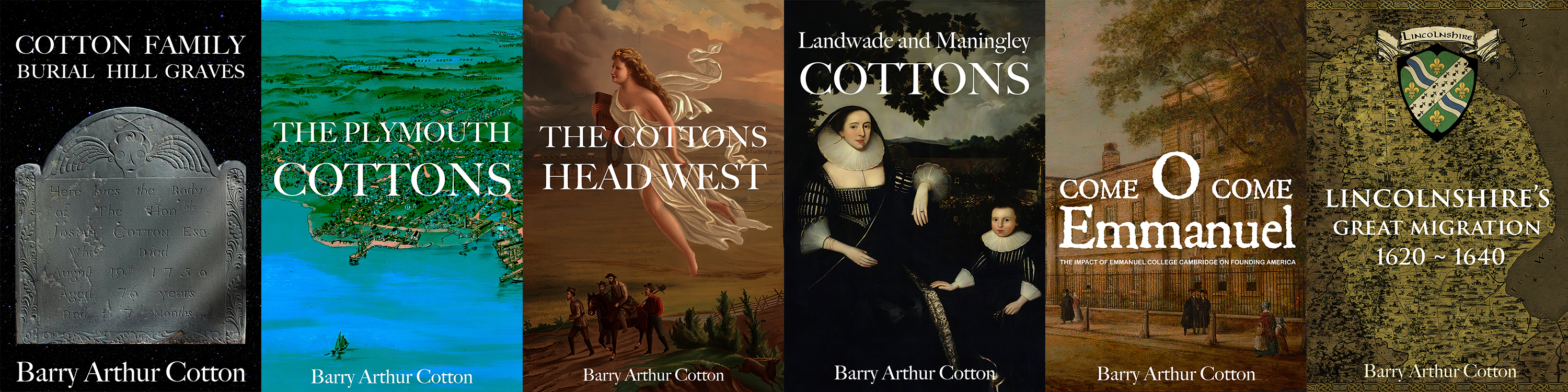
Andy was entirely charming and honest. We hit it off  with the realization that my work would never be picked up by an agent or a publisher because it has little market value. The work is a biography of John Cotton, the 17th-century puritan patriarch of New England who left Boston, England and helped establish Boston, Massachusetts. Andy said that normally an academic publisher might be interested but only if I were to have “academic credentials”, which is to say a member of academia with Ph.D. I already knew this but it was good to hear Andy say, “Your work is written very well.” Like most wanna-be writers, I need as much encouragement as I can get. My time with Andy wrapped up with us agreeing that the best route for me is to self-publish. So stay tuned, as I continue down that path.

COTTON HAPLOGROUP

My FamilyTree DNA test results resulted in a new Haplogroup that contains both my results and two Singletons. The Haplogroup is defined as BY2574.Cotton R-ZZ7Cascading down from Z255 to L159 to ZZ7_1, Haplogroup BY2574 shares BY2573 with a Byrne and a Brabazon as shown on THE BIG TREE Chart for R-ZZ7. Thanks to the wonderful work of Alex Williamson, those who take FamilyTree DNA’s Big Y Test are able to see how their haplogroup is embedded in a broader DNA Tree.   http://www.ytree.net/DisplayTree.php?blockID=132

As a result, a Singleton and I were able to make email contact with each other to establish a historical/genealogical nexus with DNA testing. Both families appear in English History during the 12th century in the Chartulary of Cockersand, Vol. I, Part II, p.263 states that Huck de Singleton was born c1100 at Little Singleton, Kirkham, Lancashire and died in Broughton, Preston, Lancashire sometime after 1170.

Three generations later, Huck’s grandson, Robert de Singleton, had a son named Richard (circa 1204) who purchased land in the village of Cottam and thus changed his surname to Cottam and became Richard de Cottam. Geoffrey de Glazebrook and Edith his wife released to Richard de Cottam an oxgang of land in Bilsborrow in 1227.” Final Conc. (Rec. Soc. Lancs, and Ches.), i, 47.

R-ZZ7 separates into haplogroups as detailed in Big Tree data for R-ZZ7 (above). The Big Tree data for R-ZZ7 above shows two Singletons and a single Cotton under R-BY2574 with a single Byrne under R-BY2573. Yet, R-ZZ7 is dominated by the Irish O’ Byrne Clan descended from Bran mac Málmórda, King of Leinster, of the Uí Faelain. The single Byrne in haplogrop R-BY2573 is Irish while the two Singletons and single Cotton in haplogroup R-BY2574 are English. As I am the single Cotton sharing haplogroup R-BY2574 with two Singleton cousins, I cannot help but be curious as to how and why our Irish DNA journeyed across the Irish Sea. Surprisingly, the answer appears that they were taken to across the Irish Sea with Vikings fleeing Dublin.

The Viking Kingdom of Dublin was established in Ireland in the mid-9th century. Early in the 10th century, however, a united Irish force from the Kingdoms of Brega and Leinster drove the Viking King Ímar ua Ímair and his warlord, Ingimundr, out of Dublin in 902AD. Ingimundr fled across the Irish Sea to the Wirral Peninsula in the far north of the Kingdom of Mercia between Wales and The Dane Law. King Ímar ua Ímair led his followers to Scotland where he confronted Constantine, King of the Picts, and was eventually defeated by Constantine at Strath Erenn. In 917, Ímar ua Ímair returned to Dublin and defeated the armies of Leinster. Ingimundr and his followers settled on the Wirral Peninsula between the Dee and Mersey estuaries and may have struck a deal with Æthelflæd, Lady of the Mercians and daughter of Alfred the Great, to safeguard the surrounding region from Viking raids. A study published in Molecular Biology and Evolution in February 2008 shows that up to 50% of men on the Wirral Peninsula are of Scandinavian ancestry.The Viking’s were notorious for capturing slaves and a large number of Irish slaves must have accompanied Ingimundr when he fled Dublin for the Wirral Peninsula in 902- including the ancestor of the Singleton/Cotton haplogroup R-BY2574. In Ireland, the King of Leinster, “Braen mac Máelmórda” was deposed in 1018 and the ClanO’Byrne was established. The time period between the Wirral Peninsula migration and the establishment of the O’Byrne line is about 100 years and coincides with the approximate separation of Singleton/Cotton haplogroup R-BY2574 from the older Irish O’Byrne haplogroup R-BY2573.

EnglandThe Lancashire Chartulary, Series XX. Charter No. II (A.D. 1153-1160 Stephen to Henry II)  contains the first historical mention of the surname “Singleton” as Ughtred, son of Huck de Singleton, of the village of Broughton in Amounderness. Just north of the Wirral Peninsula is what is now Lancashire. Historically it was divided into the Six Hundreds of Lancashire and included the Amounderness Hundred that was strategically important in the 10th century in the Dublin-York (Jórvík) axis of power. The towns of Singleton and Cottam existed in 10th century Amounderness and still lie just north of Preston in Lancashire.Lancs 1Lancs 2