




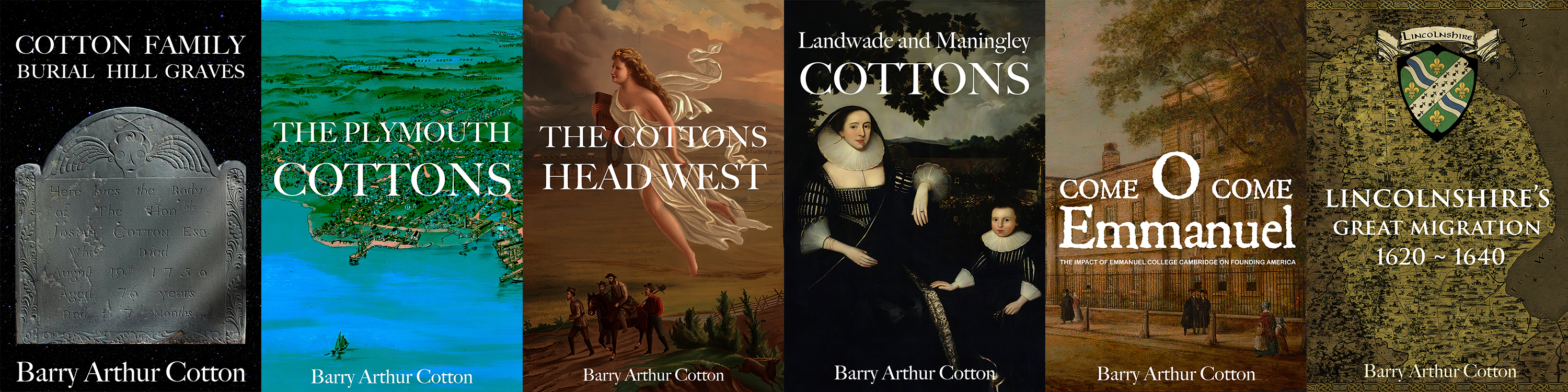









Members of Family 11 of the Cotton DNA Project include the surnames COTTON, COTTAM AND COTHAM. The Cotton surname has been proven back to Roland Cotton born London, England 1558. The Cottam surname shows a lineage back to St. Michael on Wyre, Lancashire, England to a Thomas Cottam circa 1740 and a William Cottam born 1779.
The Cotton DNA Project attempts to bridge genealogical proofs with DNA Test results. Fortunately for Family 11, the Cotton surname genealogical proof has been confirmed by a large number of prestigious lineage and hereditary societies. In addition, the Family DNA Big Y test is the most extensive DNA test available. Shown above in yellow highlight, the Cotton line’s placement has been further defined several more subclades or subgroupings under Haplogroup R-ZZ7. To my surprise, a link between the Cottam and the Cotton surnames has been revealed in results of my recent Big Y Test and is displayed on the Big Tree .
The subclade DYS435=12 groups the Cotton line solidly with the Irish Sea or Leinister Modality as the group is dominated by Z16430 and the Clan O’Byrne. The Byrne family is named after the King of Leinster “Braen mac Máelmórda”, who was deposed in 1018. However, along with the Clan Byrne subclade Z16430 is the subclade BY2573 containing a Byrne ,two Singletons and a Cotton (me). Further research seems to indicate that the Singletons took their name from the Lancashire township of Singleton. Later, in the early 12th Century, a Singleton purchased land in the nearby township of Cottam and took the surname “de Cottam”. As a result, it seems that a potential nexus of historical and DNA data exists showing that Cottam and Cotton surnames derive from the Singleton family of Lancashire early in the 14th century.
“The Lancashire Chartulary, Series XX. Charter No. II (A.D. 1153-1160 Stephen to Henry II) shows the confirmation of William Warren, Count of Mortain, to Ughtred, son of Huck de Singleton, of the village of Broughton in Amounderness. “ A note by the Chetham Society, XXX. Page 5, in their Latin comments about the Charter state, “Broctun, now Broughton, in the parish of Preston, was assessed to Danegeld in 1066 as on teamland, and was a member of Earl Tostig’s great manor of Preston in Amounderness. Hucca or Uck is the Anglo-Saxon Hoc, a tribal name retained in the place name “Hucking”. The individual so named in the charter seems to have been the successor of the preconquest thane or drengh of Broughton, and Singleton. He was the ancestor of the Singleton family, which with its various offshoots at one time held estates in Amounderness. Ughtred, son of Huck, is frequently mentioned in charters and other records of the time of Henry II. At Michaelmas, 23 Henry II, 1177, he rendered account at the Treasury of 5 marks to have the King’s confirmation or warranty of land which he held by the gift of Geoffrey de Valoiness…” Based on this charter and the notes of the Chetham Society, the following lineage has been established.1
Huck (Ecke) de Singleton (lived about 1125)
†
Ughtred (Uctred) de Singleton (lived about 1153)
†
Robert de Singleton (lived about 1180)
†
Richard de Cottam (lived about 1204)
Richard, son of Robert, owned land in the village of Cottam and thus changed his surname to conform to the common practice “of being from a place” i.e. Robert de Singleton and Richard de Cottam. (Pipe Roll, No. 71, m.I.) From the Cockersand Chartulary it appears that Richard de Cottam was son of Robert, son of Ughtred, who was brother of Richard de Singleton (1180-1212)1 Geoffrey de Glazebrook and Edith his wife in 1227 released to Richard de Cottam an oxgang of land in Bilsborrow; Final Conc. (Rec. Soc. Lancs, and Ches.), i, 47. He is believed to be the Richard son of Robert who granted land to Cockersand Abbey (Chartul. [Chet. Soc] i, 269), Robert being son of Uctred and brother of Richard de Singleton, also benefactors of the abbey; ibid. 264, 268. John de Cottam was plaintiff in 1304 and William de Cottam defendant in the following year; De Banco R. 152, m. 22 d.; 155, m. 144. William de Cottam was again defendant in 1311; ibid. 184, m. 23 d. He contributed to the subsidy of 1332; Exch. Lay Subs. (Rec. Soc. Lancs, and Ches.), 60. Sir Adam de Hoghton (as guardian of Thomas the heir of Sir Adam Banastre) gave Adam de Singleton the wardship of John son and heir of John de Cottam of Bilsborrow, the tenure being of Banastre by knight’s service; Dods. MSS. cxlix, fol. 118. The Cottams then fall into obscurity, but from a pleading of 1570 it appears that in the time of Henry IV Richard son of William Cottam married Margaret daughter of John de Fleetwood and then had land in Bilsborrow settled on him. The descent continues: s. Oliver -s. Richard -s. John -s. Richard -sons Richard (who had a son John), Nicholas and Henry. Henry’s daughter Elizabeth married Christopher Parkinson, and these were plaintiffs in 1570, Joan Topping, widow, being defendant; Pal. of Lanc. Plea R. 228, m. 10 d. The duchy rent was claimed by the king’s bailiff in 1522; Ducatus Lanc. (Rec. Com.), i, 212.4
† Geoffrey de Cottam
† John de Cottam
Writ dated at Westminster, June 10th, 21st year of Edward I (1293), directed to the sheriff of Lancaster and his coroners, reciting the same terms as the previous writ (No. LXXI) the petition of the venerable father R. Bishop of Coventre and Lichfield respecting the lands and chattels of Richard de Cotton, clerk, which had been taken into the King’s hands owing to a charge against the said Richard, of the death of William le Paumere, and directing the sheriff to make inquiry as to the said Richard’s conversation and reputation….. By the oath of 12 free and liege men of the neighborhood of Amundernesse, who say that Richard de Cotton is of good and honest conversation and of good report nor was he ever a public or notorious malefactor except for the death of William le Paumere of which he was accused (arectatus) before the Justices in the last year at Lancaster, of which he afterwards solely vindicated (expurgavit) his innocence.5
† John de Cottam (lived about 1344)
SOURCES
1 Cheshire, Record Society of Lancashire and. Record Society for the Publication of Original Documents Relating to Lancashire and Cheshire, 1903.
2 Farrer, William, and J Brownbill. The Victoria History of the County of Lancaster, 1908
3 Singleton, Sam, Singleton Family Association. A History of John Singleton of American Fork, Utah, His Ancestors and Descendants, Spanish Fork, Utah: JMart Publishing Company, 1973.
4 Cheshire, Record Society of Lancashire and. Record Society for the Publication of Original Documents Relating to Lancashire and Cheshire, 1903.
5 Ibid.
 Plymouth Rock is one of America’s most visited historic sites, but this famous chunk of bedrock wasn’t always the shrine it is today. The first settler made no mention of it in historical accounts about the famous landing on December 21, 1620. In fact, before going ashore to the mainland, they took refuge that first night at Clark’s Island, just across from the harbor.
You must be logged in to post a comment.